CCAA: biometric attendance control, towards deployment across all sites


Ahead of the general rollout of biometric attendance control across all sites hosting personnel of the Cameroon Civil Aviation Authority (CCAA), a workshop was held from August 4 to 5, 2026, at the Training School (EFO) in Yaoundé. The objective was to remove technical bottlenecks, harmonize operational procedures, and train the Heads of General Affairs Offices at headquarters and the six airport platforms in the country.

Participants pose for a group photo in front of the EFO/CCAA in Yaoundé.
Chaired by the Director of General Administration, Mr. Sama Muvah Yella, the workshop revealed losses exceeding 10 million CFA francs in the first semester of badge data use. These losses stemmed from prolonged, unjustified absences and systematically unreported delays, which undermined the Authority’s ability to respond swiftly and implement necessary precautionary measures.
The attendance control system is anchored in a clear regulatory framework. It draws on Article 9 of the internal regulations, which requires personal sign‑in at arrival and departure, and Article 23 of the Staff Statute, which links remuneration to hours actually worked, in line with the principle that salary is the counterpart of work performed.
During the workshop, the service provider identified workstation programming as the key obstacle to the pilot phase across the six airport platforms (Douala, Yaoundé‑Nsimalen, Maroua, Garoua, Ngaoundéré, and Bafoussam). Without pre‑recorded schedules, the system could not distinguish between irregular absences and authorized rest periods.
To address this, the Heads of General Affairs Offices received practical retraining to better manage attendance and absence reports. A site‑specific action plan as well as standardized procedures will serve as validated deliverables.

Managers gather around the Director of General Administration during the workshop.
A rigorous mechanism, designed to strengthen the reliability of data from badge readers, has also been established. It incorporates the observations collected and takes into account the constraints specific to each equipped site.
In accordance with the provisions of Decree No. 95/677/PM of December 18, 1995, late presence at the office does not entitle staff to any additional remuneration. Any overtime remains subject to a prior documented request formally validated by the Director General.
The full rollout of the biometric attendance control system will follow a participatory approach to secure staff buy‑in. A sensitization campaign will be launched by October 2026, in consultation with staff representatives and the Labor Inspectorate. Once operational, each employee will receive their individual attendance report electronically.
For the Director of General Administration, this transparency is a decisive lever to embed within the CCAA a culture of diligence, responsibility, and punctuality to drive institutional performance and efficiency.
Trans: MKG/CEA- CRP
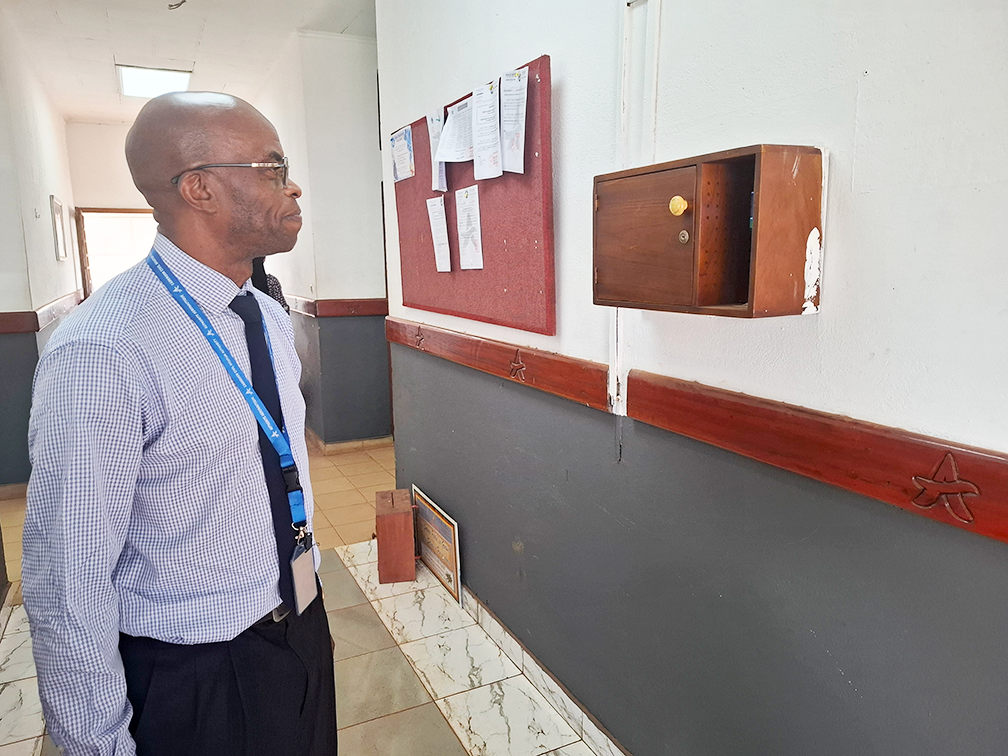
A staff member demonstrates how the biometric system works through facial recognition.